What the Cold Plunge Science Actually Says

Cold plunge marketing runs on hype dosing: take an acute lab finding, stretch it into a lifetime health claim, and sell a tub against it. This page is the unstretched version. We sort the claims into four bins: solid, promising, thin, and actively negative. If a finding moves bins as new research lands, this page changes.
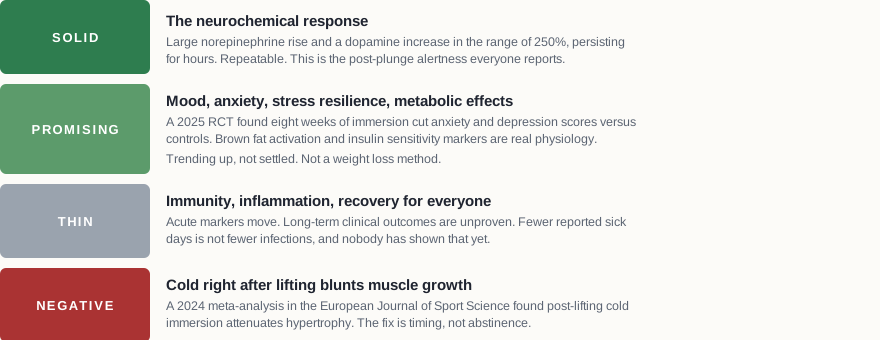
Solid: The Neurochemical Response
The best-documented effect of cold water immersion is the catecholamine surge. Immersion in water around 10 to 15°C produces a large rise in norepinephrine and a dopamine increase in the range of 250%, with elevated levels persisting for hours afterward. This is the mechanism behind the post-plunge state everyone reports: alert, clear, mildly euphoric. It's real, it's repeatable, and it's why morning is the default timing and late nights are not.
Worth saying plainly: an acute dopamine rise is a state, not a trait. The interesting question is whether repeated exposure changes your baseline. Søberg's winter-swimmer work suggests it can, which is where the famous 11 minutes per week figure comes from, and it's the basis of our protocol.
Promising: Mood, Anxiety, and Stress Resilience
This bin upgraded recently. A 2025 randomized controlled trial found that eight weeks of regular cold water immersion produced meaningful reductions in anxiety and depression scores versus controls, and a separate 2025 study in PLOS ONE found improved stress resilience markers over the same time frame. That's the right kind of evidence: controlled, weeks long, against humans rather than mechanisms.
The caution: a 2025 systematic review across the whole literature still found inconsistent mood results between studies, with small samples and wildly varying protocols. So: promising and trending up, not settled. If you plunge for mental state, the acute effect alone may justify it. Just don't let anyone sell it to you as treatment for a clinical condition; if that's the situation, the water is an adjunct, not the plan.
Promising: Metabolic Effects
Repeated cold exposure activates brown adipose tissue, which burns glucose and fat to make heat. Søberg's research found winter swimmers had more active brown fat and better insulin sensitivity markers, and a 2025 study found cold exposure after a carb-heavy meal cut the glucose spike by 20 to 30%. Real physiology, measurable effects.
What it is not: a weight loss method. The calorie cost of plunging is modest, and no controlled study shows meaningful fat loss from cold water immersion alone. Anyone doing that math for you in a sales page is selling the tub, not the truth.
Thin: Immunity, Inflammation, Recovery for Everyone
- Immunity: cold exposure mobilizes immune cells acutely, and one well-known Dutch study found fewer sick-day reports among cold shower takers. Fewer reported sick days is not fewer infections, and nobody has shown that yet.
- Inflammation: acute markers move; long-term clinical outcomes are unproven.
- Soreness: cold water immersion does reduce delayed-onset muscle soreness. That's one of the older, better-replicated findings in sports science. But read the next section before you celebrate, because the soreness relief and the adaptation blunting are two ends of the same mechanism.
Negative: Cold After Lifting Blunts Muscle Growth
This is the finding the cold plunge industry would rather you not read. A 2024 systematic review and meta-analysis by Piñero and colleagues in the European Journal of Sport Science, titled "Throwing cold water on muscle growth," pooled the controlled studies on post-lifting cold immersion and found that it attenuates hypertrophy compared to lifting alone. An earlier trial in the Journal of Applied Physiology found the same pattern at the muscle fiber level, with strength gains less affected than size.
The mechanism is straightforward: the inflammation and blood flow that cold suppresses are part of the signal that tells muscle to grow. Kill the signal, blunt the growth. The fix is timing, not abstinence, and it's spelled out on the timing page: keep 4 to 6 hours between lifting and cold, or plunge on rest and cardio days.
The authors graded the underlying studies fair to poor quality, so the effect size carries uncertainty. But notice the asymmetry: the only directional evidence we have says cold right after lifting costs you gains. There is no study showing it helps them.
How to Read This Whole Page
Plunge because: the acute alertness and mood effect is reliable, the anxiety evidence is getting real, and a hard thing done every morning compounds in ways no lab measures.
Don't plunge because: you were promised fat loss, immunity, or longevity. That's not what the record shows yet.
And never plunge: right after hypertrophy training, or against the contraindications on the safety page.
The practice doesn't need inflated claims. Eleven minutes a week, properly dosed, earns its place on the honest evidence alone. That's the bet this site makes. Start with the protocol.